Being told you might need screws and rods in your spine is frightening. Most patients in North Bengal hear the words “spinal fixation” for the first time in a doctor’s chamber, often after months of back pain, a fall, or a road accident. The questions start immediately. Is surgery really necessary? Is there another way? Who should do it?
This guide answers those questions honestly. It covers what spinal fixation surgery in Siliguri involves, when it is genuinely needed, how surgeons confirm spinal instability, and what recovery looks like, so you can walk into your consultation prepared.
What Is Spinal Fixation Surgery?
Spinal fixation is a procedure in which a surgeon uses implants, usually titanium screws, rods, or plates, to hold two or more vertebrae steady. The goal is to stop harmful movement between bones that should be stable, restore alignment, and protect the spinal cord and nerves.
A widely cited radiology review in Radiographics (Slone et al., 1993, PubMed 8460224) makes an important point that many patients never hear. Fixation devices give the spine immediate stability, but they are not built to carry load indefinitely, and in most cases they will eventually fail if the bones do not fuse.
*Looking for specialist guidance for a complex spine condition? Learn what to consider when choosing a neurosurgeon in Siliguri before planning your treatment.
Fixation vs. Fusion: What’s the Difference?
This is why fixation and fusion almost always go together. The hardware acts as internal scaffolding. Bone graft is placed to encourage the vertebrae to grow into a single solid segment, and that fusion is what provides lasting stability. Put simply, the screws and rods hold everything in place while your body builds the permanent repair.
When Is Spinal Fixation Surgery Needed?
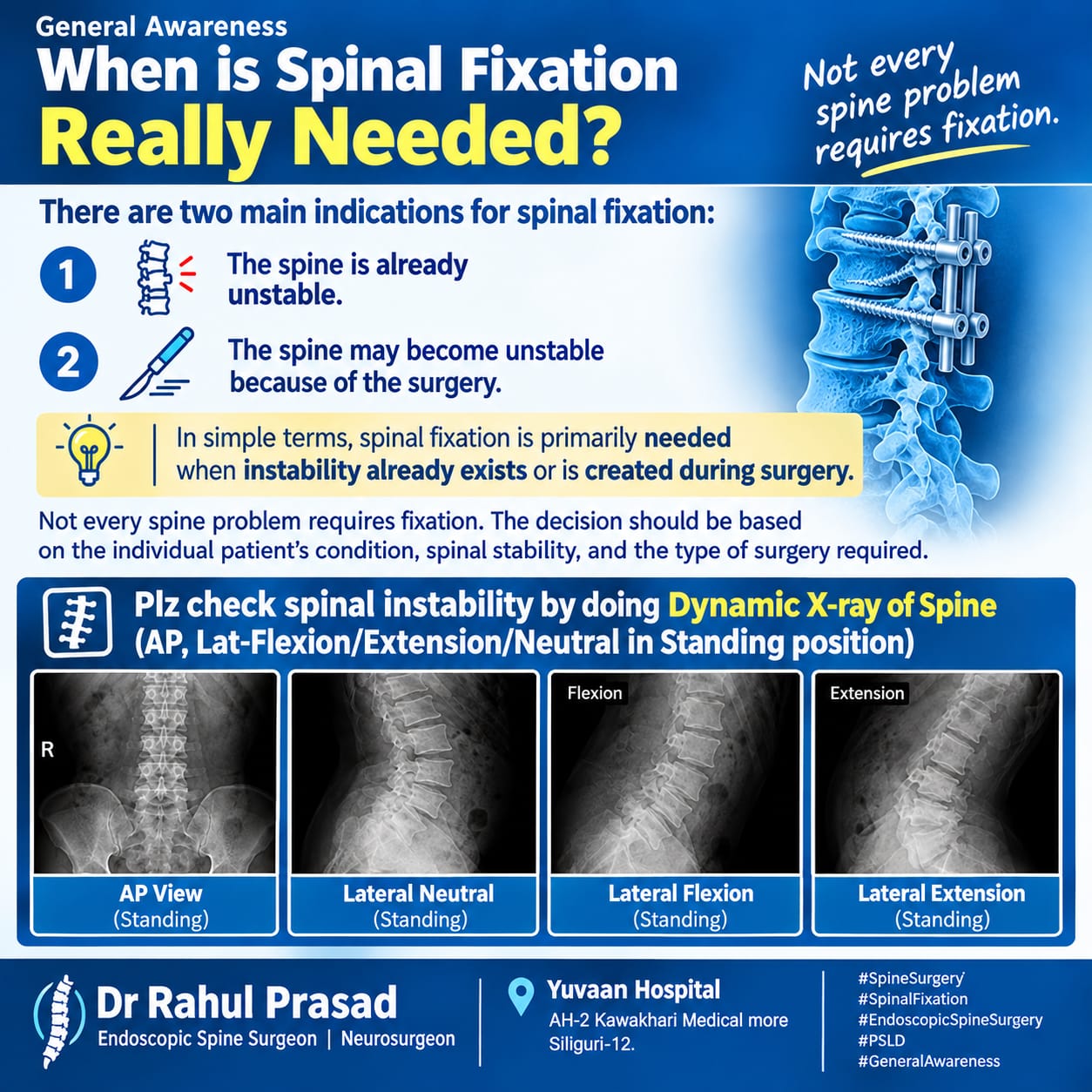
Fixation is needed when a part of the spine is unstable, meaning it moves abnormally under normal loads in a way that threatens the nerves, causes significant pain, or risks progressive deformity. Pain alone is not an indication. Most back and neck pain improves without any surgery at all.
Common reasons a spine surgeon may recommend fixation include:
- Spinal fractures: unstable vertebral fractures after road accidents, falls from height, or osteoporotic collapse.
- Spondylolisthesis: one vertebra slipping forward over another, particularly when the slip is mobile or causing nerve compression.
- Instability after decompression: when removing enough bone to free trapped nerves would otherwise leave the segment unstable.
- Spinal infections and tumours: when disease has destroyed bone that normally supports the spine.
- Deformity: such as scoliosis or kyphosis that is progressing or affecting function.
These are broadly the same categories the medical literature lists: fractures, degenerative disease, infection, tumours, and congenital deformities such as scoliosis.
Signs That Should Prompt an Urgent Review
Seek prompt specialist attention if back or neck pain comes with weakness in the arms or legs, numbness spreading down a limb, difficulty walking, or any change in bladder or bowel control. These signs suggest nerve or spinal cord compression, which is time-sensitive.
Spinal Fixation for Spinal Instability: How Is Instability Diagnosed?
Instability is not something a surgeon should assume from symptoms. It needs to be demonstrated. The work-up usually combines a clinical examination with imaging, and each test answers a different question.
*If your symptoms involve persistent neck pain or nerve-related discomfort, explore neck pain treatment in Siliguri and learn when specialist evaluation may be needed.
Why a Dynamic X-Ray Matters
An MRI is taken while you lie still. It shows discs, nerves, and soft tissue in excellent detail, but it cannot show how your spine behaves when you move. That’s the job of a dynamic X-ray, also called a flexion-extension X-ray.
You are asked to bend forward and then lean back while X-rays are taken in each position. The surgeon compares the two images to see whether a vertebra slides or tilts more than it should. A slip that looks mild on a lying-down MRI may shift noticeably on bending, and that difference can change the treatment plan entirely. Exact thresholds for “abnormal” movement vary between studies and spinal levels, so the result is always read alongside your symptoms and examination findings.
CT scans help assess bone detail and fracture patterns. MRI shows nerve compression. Together with dynamic X-rays, these tests help separate a spine that is painful but stable, where physiotherapy and medication may be enough, from one that genuinely needs stabilisation.
What Happens During the Procedure?
Surgery is performed under general anaesthesia. Using imaging guidance, the surgeon places screws into the vertebrae above and below the problem area and connects them with rods. Any compressed nerves are freed, and bone graft is placed to start fusion.
Depending on the condition, this may be done through a traditional open incision or with minimally invasive techniques, where screws are inserted through smaller incisions with less disruption to the back muscles. Not every case suits a minimally invasive approach. Complex fractures, infections, and deformities often need open surgery, and a good surgeon will explain why one approach is chosen over another for you.
Spinal Fixation Surgery Recovery: What to Expect
Recovery varies with age, bone quality, the number of levels fixed, and the underlying condition. The timeline below reflects typical patterns, not a promise.
In hospital (first few days): Most patients are helped to sit up and walk within a day or two. Pain is managed with medication, and a physiotherapist teaches safe ways to get out of bed, sit, and stand. Hospital stay is commonly a few days for straightforward cases.
First six weeks: Walking is encouraged daily and gradually increased. Bending, twisting, and lifting anything heavy are avoided. Some patients are advised to wear a brace. Those with desk jobs may return to work within this window if recovery is smooth.
Six weeks to three months: Structured physiotherapy builds core and back strength. Follow-up X-rays check implant position and early healing. Physically demanding work usually needs longer.
Three to twelve months: Bone fusion matures over many months. Most patients notice steady improvement through this period.
A few things make a real difference to healing. Stopping smoking and tobacco is one of them, because it is strongly linked to poor fusion. Others include good nutrition, managing diabetes, and attending every follow-up.
*Want to understand what to look for in a spine and neurosurgery specialist? Read this guide to choosing a neurosurgeon doctor in Siliguri before your consultation.
How to Choose a Spinal Fixation Surgeon in Siliguri
The word “best” appears on almost every surgeon’s website, which makes it nearly meaningless. It’s more useful to look for specific things:
- Relevant training: spine surgery is performed by both neurosurgeons and orthopaedic spine surgeons. Look for formal super-specialty training (MCh or DNB) and dedicated spine fellowship experience.
- Honest assessment: a good surgeon explains why surgery is needed, what the alternatives are, and what happens if you wait. Be cautious if non-surgical options are dismissed without discussion.
- Evidence of instability: ask whether dynamic X-rays or other tests confirmed the need for fixation.
- Clear expectations: ask about realistic recovery time, risks, and what outcome you can expect in your specific case.
- Hospital support: spine surgery needs a proper operating theatre with intraoperative imaging, ICU backup, and physiotherapy.
Consulting Dr. Rahul Prasad for Spine Care in Siliguri
Dr. Rahul Prasad is a neurosurgeon and spine surgeon practising in Siliguri. He completed his MS in General Surgery at Banaras Hindu University and his MCh in Neurosurgery at G.B. Pant Hospital, New Delhi, followed by a clinical fellowship in minimally invasive and complex spine surgery at Temple University Hospital in the USA and an endoscopic spine fellowship in South Korea.
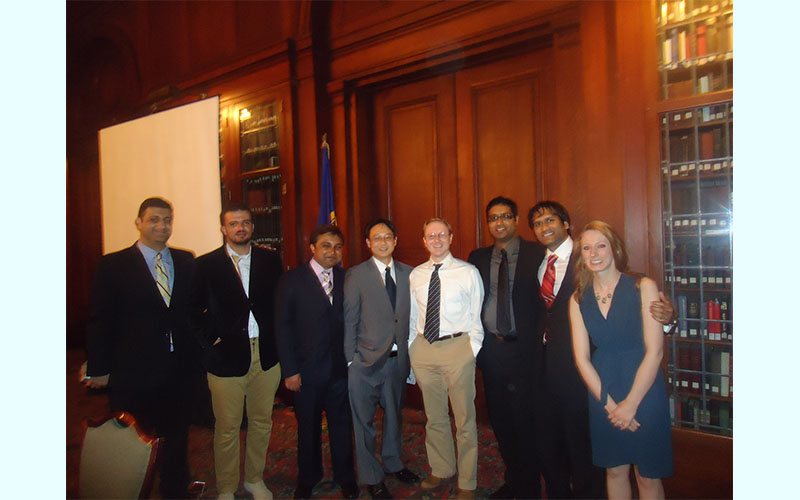
He practises as a Senior Neurosurgeon and Spine Surgeon at Yuvaan Hospital, Siliguri, and previously worked as a consultant at hospitals including Wockhardt Hospital (Goa), Yashoda Hospital (Delhi NCR), Max Super Speciality Hospital (New Delhi), and Rajasthan Hospital (Ahmedabad). He is a member of professional bodies including the Congress of Neurological Surgeons, the North American Spine Society, and the Neurological Society of India.
If you have been advised spinal fixation, or want a second opinion before deciding, bring your MRI, CT, and any X-ray reports to your consultation. That lets the discussion focus on your spine rather than generalities.
*Looking for advanced treatment options? Explore minimally invasive and complex spine surgery to understand modern surgical approaches for complex spinal conditions.
Frequently Asked Questions:
Is spinal fixation surgery safe?
Spinal fixation is a well-established procedure, but like any major surgery it carries risks, including infection, bleeding, nerve injury, implant problems, and failure of fusion. Your surgeon should discuss your individual risk based on your age, health, and condition.
Do the screws and rods stay in forever?
Usually, yes. Once fusion is complete, the implants generally cause no problems and are left in place. Removal is considered only in specific situations, such as infection or implant-related pain.
Can I avoid surgery with physiotherapy?
Often, yes. Many people with back pain, disc problems, and even mild spondylolisthesis improve with physiotherapy, medication, and activity changes. Fixation is generally reserved for proven instability, nerve compression that isn’t improving, or injuries that can’t heal safely on their own.
Will I be able to bend normally after fixation?
Fusing one or two levels usually causes little noticeable stiffness in daily life, because the rest of the spine shares the movement. Longer fusions limit flexibility more, and your surgeon can tell you what to expect for your case.
How long before I can ride a two-wheeler or travel?
This depends on your recovery and the type of surgery. Many surgeons advise waiting several weeks before riding or long journeys. Ask your surgeon for guidance specific to your case.
Take the Next Step With Clear Answers
Spinal fixation can be life-changing when it is truly needed, and unnecessary when it isn’t. The right decision starts with a careful diagnosis, a clear explanation, and a surgeon who takes time to answer your questions. To discuss your reports or book a consultation, visit drrahulprasad.com.